
Urdu vs Roman Urdu Captions: Which Script Should You Publish?
Decide between Urdu script and Roman Urdu captions for Reels and TikTok. Use audience comments, reading habits, and export needs so your on-screen words match how people already read.
Caption your next video free

Omar Raza
Urdu vs Roman Urdu Captions: Which Script Should You Publish?
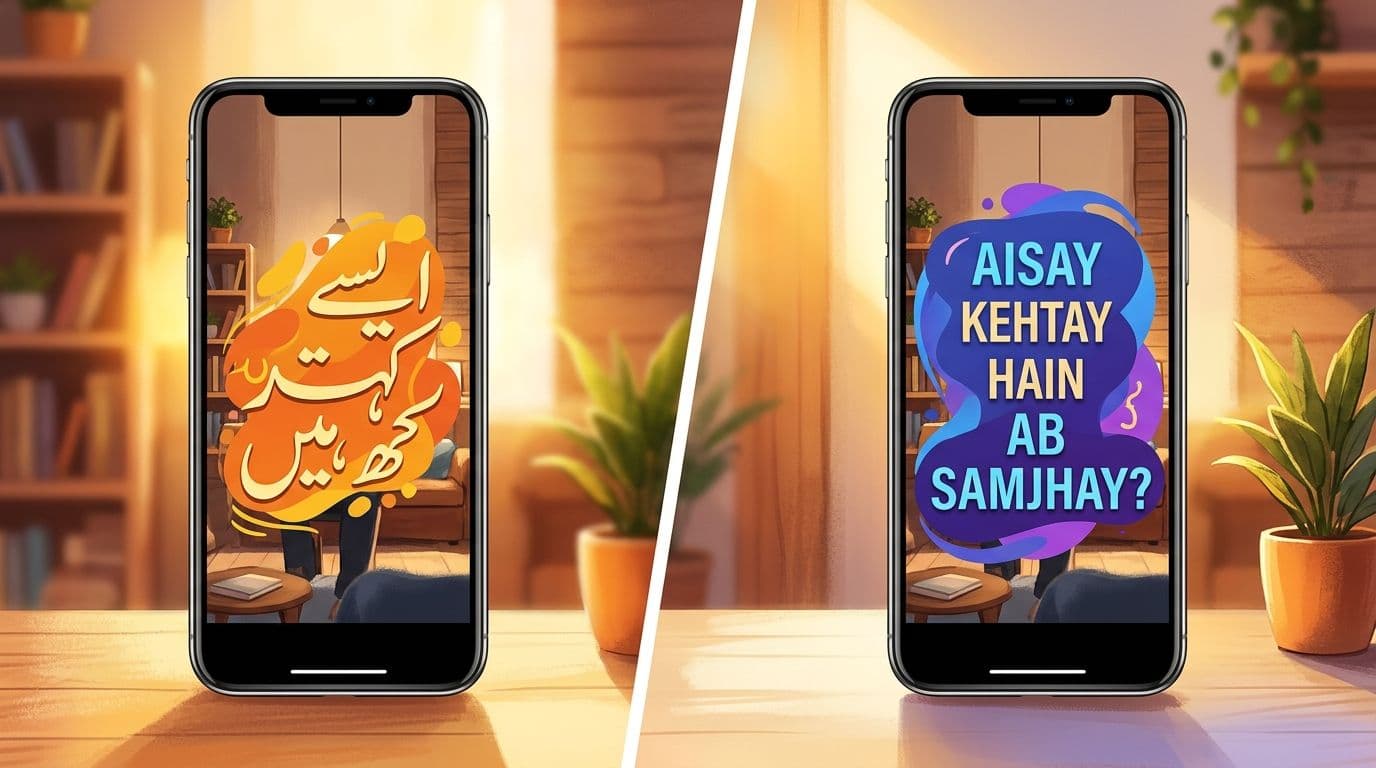
Urdu vs Roman Urdu captions is an audience decision first, not a font decision. Urdu script uses Perso-Arabic letters. Roman Urdu writes the same spoken language with English letters the way people type in WhatsApp and Instagram comments.
Publish the script your viewers already read without translating in their head. Mixing both randomly makes every post feel harder than it needs to be.
The two scripts in plain terms
| Script | What viewers see | Feels natural when |
|---|---|---|
| Urdu script | اردو letters on screen | Viewers read Urdu news, books, or formal posts in that script |
| Roman Urdu | Latin letters like "yaar yeh scene" | Viewers comment and DM in English letters |
Neither choice is "more correct" for social video. Correct means readable for the people you want to keep.
Read your last 20 comments
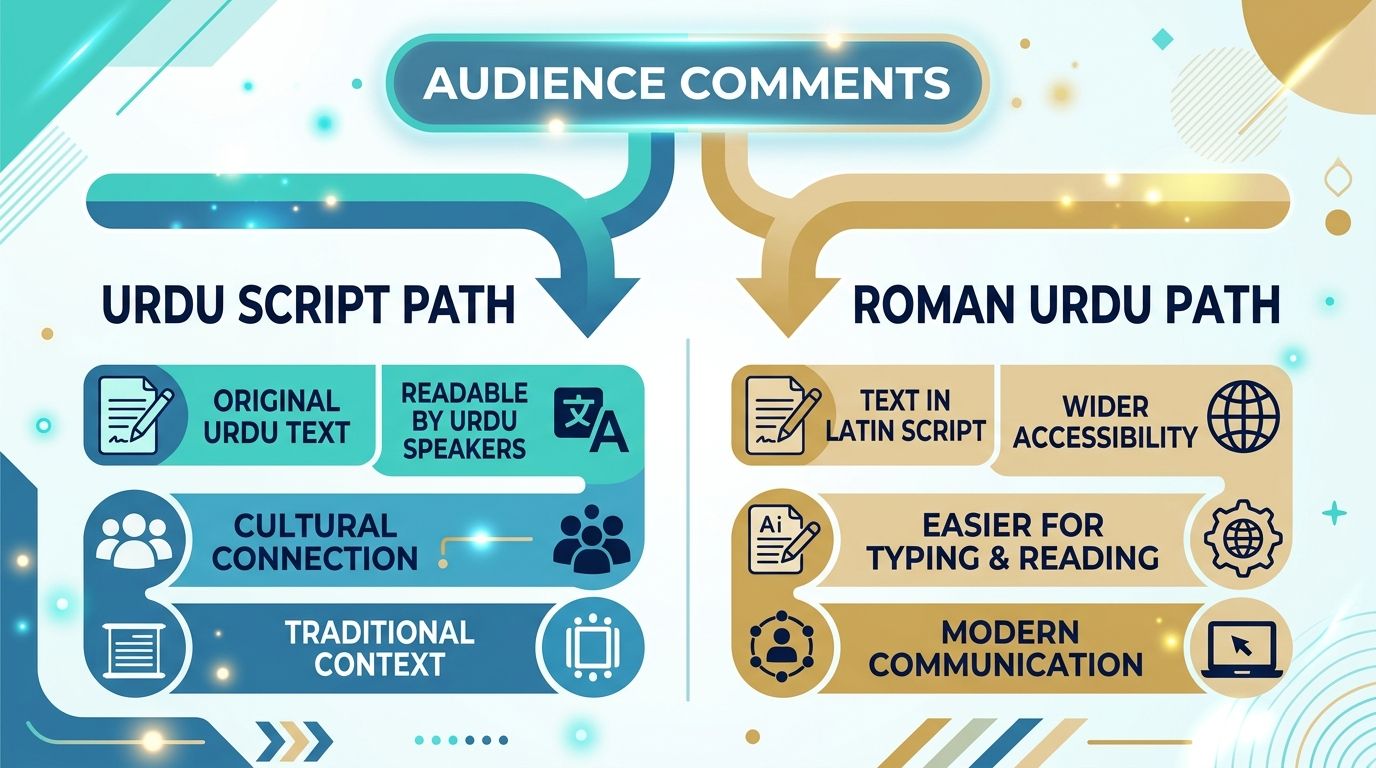
Before you change tools, open your recent posts.
- If comments are mostly Urdu script, lean Urdu script on screen.
- If comments are mostly Roman Urdu or English, lean Roman Urdu.
- If you serve two clear segments (for example Karachi teens and a diaspora auntie group), consider two exports, not one muddy hybrid.
Your comment language is a better signal than a generic "Pakistani audience" label.
When Urdu script is the better default
Choose Urdu script when:
- The channel voice is formal, news-like, religious, literary, or brand-premium.
- Viewers already expect Urdu letters on thumbnails and posts.
- You need the shape of the writing itself to feel culturally on-brand.
Urdu script on vertical video needs careful sizing and usually looks most reliable when the words are saved into the video file, so apps do not swap the font. Details live in Urdu script captions for Reels.
When Roman Urdu is the better default
Choose Roman Urdu when:
- Your audience already types that way in chats.
- You mix English product names and want one Latin line to stay simple.
- Speed and everyday tone matter more than formal script aesthetics.
Spellings vary (kyun vs kyu, hai vs he). Pick the spellings your community uses and stay consistent. A full workflow is in Roman Urdu caption generator for Reels and TikTok.
Mixed Urdu-English speech
Many clips switch languages mid-sentence. That is normal. The script choice still needs a primary home:
- Primary Roman Urdu: keep English brand names as English.
- Primary Urdu script: keep English names in Latin letters inside the Urdu line when that is how people say them.
Do not auto-force every English word into Urdu letters if viewers never read those names that way. For cleanup patterns, see how to caption mixed Urdu-English videos.
Should you publish both?
Two exports make sense when:
- One post targets a local Urdu-script heavy segment and another targets a diaspora Roman Urdu segment.
- A client pays for both.
- A key announcement needs maximum reach across reading habits.
Two exports are usually overkill for daily casual clips. Pick one primary script for the channel and stick with it for a month so the feed feels intentional.
Common mistakes
- Starting in Urdu script, then switching to Roman Urdu next week with no audience reason
- Tiny Urdu script that collapses on mobile compression
- Roman Urdu lines that are full English paragraphs with two Urdu words stuck in
- Trusting the first auto transcript without fixing names, places, and religious terms
A five-minute decision checklist
- Scroll comments: which script dominates?
- Say the channel goal out loud: casual chat or formal presence?
- Check one competitor your audience already watches.
- Generate a 20 second test in your chosen script.
- Watch it muted on a phone before you batch the week.
Channel examples (use as patterns, not rules)
Local food review in Lahore. Comments arrive in Roman Urdu and English. Roman Urdu captions usually match how viewers already joke in the thread.
Islamic reminder or poetry page. Viewers often expect Urdu script. Roman Urdu can feel casual in the wrong way even when it is readable.
Diaspora comedy for people who left Pakistan years ago. Roman Urdu plus English product names is often the path of least resistance.
B2B founder talking to Pakistani startups. Mixed. Check whether the LinkedIn audience and the TikTok audience are the same people before you force one script everywhere.
These are patterns from reading habits, not moral rankings of scripts.
What to tell an editor or VA
If someone else captions for you, write the rule once:
- Primary script for this channel is X.
- English brand names stay in English letters.
- Do not invent a new Roman Urdu spelling each week for the same word.
- Always proof names of people and places.
- Export a phone-sized preview before scheduling.
Clear rules prevent the feed from oscillating between formal Urdu script and chatty Roman Urdu without intention.
Practical recommendation
Default to the script your comments already use. Use Urdu script when formality and cultural presence matter. Use Roman Urdu when chat-style speed and Latin-letter comfort matter. Keep mixed speech honest, proof names, and avoid flipping scripts for novelty.
If you already know the answer is Roman Urdu, start from the Roman Urdu captions landing. If you need Urdu letters saved into the file, follow the Urdu script guide linked above and export a version you can read at phone distance.
Written by
Omar Raza
Language and accessibility specialist at AutoCaption. Focused on Urdu script, Roman Urdu, and right-to-left caption workflows.